
Numbers to Leave Numbers
It’s just a five footer. Left edge. Trust your stroke.
The stroke feels solid, and the ball leaves the face online. Then a sinking reality hits.
It’s turning left. How the f*** is it turning left? FFS.
Many of us have fallen victim to the complete misread. Some of us have lost matches or missed out on personal best scores. The subsequent emotional upheaval can cause lasting damage. But the worst part of this scenario?
It’s the result of guesswork.
A fundamental understanding of how and why a ball breaks should be a core principle for any player, especially a junior golfer that is looking to compete. AimPoint Express has served as a great tool for players to acquire those skills.
There are many coaches that champion the value of said skills. After all, determining slope and start line is essential for every putt that isn’t a mere tap in. Then there are other coaches who wag fingers citing AimPoint as a short cut that hinders growth and experience.
Here’s one example from James Jankowski (@jjgolfputting):
“Controversial opinion: I’m not a fan of AimPoint Express for juniors. Introduce it later if/when green reading needs improvement. Used too early, it can stifle learning key skills, visualization, and creativity. Be careful chasing quick gains that hinder long-term development.”
Is this statement in its current capacity ignorant? 100 percent. Click-bait driven? Also yes.

But before we all jump down his throat for the sensationalist approach worthy of the National Enquirer, let’s hear him out. What are the valid concerns of this post?
Stifling the learning of skills
Limiting visualization
Reducing creativity
Short cutting the process
Looking at that list alone and completely detaching it from the first two sentences, I think any coach would be hard pressed to suggest any of those 4 items are traits they want for their players.
And that logic triggered a dive into pedagogy and its relevance to coaching. Seth Godin puts it perfectly:
“If you need to get attached to the outcome because you need more, now you’re not doing the work. Now you’re just simply trading for the outcome.” — Seth Godin (Tim Ferriss Podcast Episode #476)
Now re-read the quote with some golf mixed into the sentence:
“If you need to get attached to the outcome because you need to make more putts, now you’re not doing the work. Now you’re just simply trading for the outcome.”
That right there. That is every parent of a junior golfer that signed their kid up for an AimPoint class under the impression that it was the be all end all solution to holing more putts, winning tournaments, securing the college scholarship, and going right to the Tour at 22 years old.
Only attending that one class skips the 3 very valid points in JJ’s original post. However, here is where he and I will deviate in our opinion. Perhaps my delivery will be met with less controversy:
“Less controversial opinion: I’m a fan of AimPoint Express for juniors. Used early, it establishes foundational skills for understanding slope, stimp, and why a ball breaks. Be careful chasing quick gains as AimPoint Express is just the first step. Used to its fullest extent, it serves as a tool to help players add depth to the learning skills, improve visualization, and enhance creativity.”
There’s many more layers to becoming a proficient green reader than holding up fingers and picking a target. I am willing to concede the westernized mindset of trading for an outcome is part of what I coach out of my players on a regular basis. It’s the crux of last week’s Preston’s Post-it Note:
“Numbers to leave numbers. Form to leave form.” — Josh Waitzkin, The Art of Learning
Josh continues to describe later in the book what that means on a deeper level:
“I am describing a process in which technical information is integrated into what feels like natural intelligence. Sometimes there will literally be numbers. Other times there will be principles, patterns, variations, techniques, ideas. A good literal example of this process, one that does in fact involve numbers, is a beginner’s very first chess lesson. All chess players learn that the pieces have numerically equivalents - bishops and knights are worth three pawns, a rook is five pawns, a queen is nine. Novices are counting on their hands or on their fingers before they make exchanges. In time, they will stop counting. The pieces will achieve a more flowing and integrated value system. They will move across the board like fields of force. What was once seen mathematically now felt intuitively.” — Josh Waitzkin (74)
Using AimPoint Express as a tool will at first look like chess players using their hands to count the value of pieces. And even after much experience, the system ironically will still demand the use of your hands and fingers.
However, consider that knowledge of slope values can help players accurately determine entry point, a spot where a putt is expected to cross the front edge of the hole.
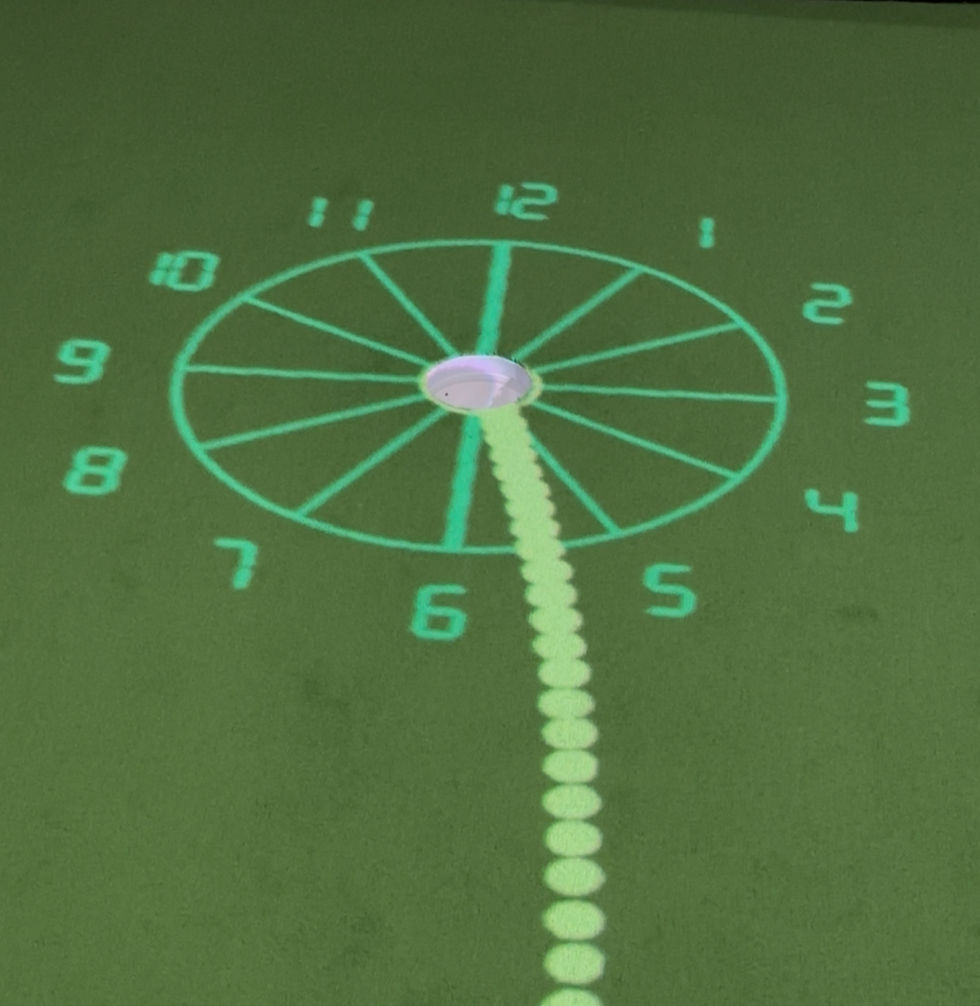
Knowing a start line also helps players accurately visualize the curvature of their putt rather than arbitrarily guessing where they think the ball should travel.

AimPoint is also a step towards learning what a DropPoint is and accurately seeing the curvature in the last 3 feet of a putt.

No, the complete picture isn’t guesswork. It is a process, just like Waitzkin suggests. Feels aren’t born, but rather cultivated and built around a foundation. Intuition isn’t traded for, it’s earned.
Next time you’re standing over a five footer that matters, will you be relying on guesswork? Or will you use numbers to leave numbers? Will you have invested in a sound foundation and acquired a separating natural intelligence?


Comments